


 ► Longships were
naval vessels made and used by the Vikings from Scandinavia and Iceland
for trade, commerce, exploration, and warfare during the Viking Age.
The longship’s design evolved over many years, beginning in the Stone
Age with the invention of the umiak and continuing up to the 9th century
with the Nydam and Kvalsund ships. The longship appeared in its
complete form between the 9th and 13th centuries. The character and
appearance of these ships have been reflected in Scandinavian
boat-building traditions until today. The average speed of Viking ships
varied from ship to ship but lay in the range of 5–10 knots and the
maximal speed of a longship under favorable conditions was around 15
knots.
► Longships were
naval vessels made and used by the Vikings from Scandinavia and Iceland
for trade, commerce, exploration, and warfare during the Viking Age.
The longship’s design evolved over many years, beginning in the Stone
Age with the invention of the umiak and continuing up to the 9th century
with the Nydam and Kvalsund ships. The longship appeared in its
complete form between the 9th and 13th centuries. The character and
appearance of these ships have been reflected in Scandinavian
boat-building traditions until today. The average speed of Viking ships
varied from ship to ship but lay in the range of 5–10 knots and the
maximal speed of a longship under favorable conditions was around 15
knots. ► The long-ship is characterized as a graceful, long, narrow, light,
wooden boat with a shallow draft hull designed for speed. The ship's
shallow draft allowed navigation in waters only one metre deep and
permitted beach landings, while its light weight enabled it to be
carried over portages. Longships were also double-ended, the symmetrical
bow and stern allowing the ship to reverse direction quickly without
having to turn around; this trait proved particularly useful in northern
latitudes where icebergs and sea ice posed hazards to navigation.
Longships were fitted with oars along almost the entire length of the
boat itself. Later versions sported a rectangular sail on a single mast
which was used to replace or augment the effort of the rowers,
particularly during long journeys.
► The long-ship is characterized as a graceful, long, narrow, light,
wooden boat with a shallow draft hull designed for speed. The ship's
shallow draft allowed navigation in waters only one metre deep and
permitted beach landings, while its light weight enabled it to be
carried over portages. Longships were also double-ended, the symmetrical
bow and stern allowing the ship to reverse direction quickly without
having to turn around; this trait proved particularly useful in northern
latitudes where icebergs and sea ice posed hazards to navigation.
Longships were fitted with oars along almost the entire length of the
boat itself. Later versions sported a rectangular sail on a single mast
which was used to replace or augment the effort of the rowers,
particularly during long journeys. 
 ► Longships were the epitome of Scandinavian naval power at the time, and were highly valued possessions. They were often owned by coastal farmers and commissioned by the king in times of conflict, in order to build a powerful naval force. While longships were used by the Norse in warfare, they were troop transports, not warships. Inthe tenth century, these boats would sometimes be tied together in battle to form a steady platform for infantry warfare. They were called dragonships by enemies such as the English because they had a dragon-shaped bow. The Norse had a strong sense of naval architecture, and during the 8th–11th centuries, they were advanced for their time,[says who?] compared to other European nations (earlier shipbuilding techniques, for example those of Mediterranean peoples, such as ancient Greece and Rome, were far more sophisticated and varied, especially in terms of joinery).
Types of longships
► Longships can be classified into a number of different types,
depending on size, construction details, and prestige. The most common
way to classify longships is by the number of rowing positions on board.
Karvi
 ► The Karvi are the smallest vessel that is considered a longship.
According to the 10th century Gulating Law, a ship with 13 rowing
benches is the smallest ship suitable for military use. A ship with
between 6 and 16 benches would be classified as a Karvi. These ships
were considered to be “general purpose” ships, mainly used for fishing
and trade, but occasionally were commissioned for military use. While
most longships held a length to width ratio of 7:1, the Karvi ships were
closer to 4.5:1.
► The Karvi are the smallest vessel that is considered a longship.
According to the 10th century Gulating Law, a ship with 13 rowing
benches is the smallest ship suitable for military use. A ship with
between 6 and 16 benches would be classified as a Karvi. These ships
were considered to be “general purpose” ships, mainly used for fishing
and trade, but occasionally were commissioned for military use. While
most longships held a length to width ratio of 7:1, the Karvi ships were
closer to 4.5:1.  |
| Gokstad Karvi |
Snekkja

► The Snekkja, meaning 'thin and projecting,' was typically the
smallest longship used in warfare and was classified as a ship with at
least 20 rowing benches. A typical snekkja might have a length of 17
metres (56 ft), a width of 2.5 metres (8.2 ft), and a draught of only
0.5 metres (1.6 ft). It would carry a crew of around 41 men (40 oarsmen
and one cox).
 ► Snekkjas were one of the most common types of ship. According to
Viking lore, Canute the Great used 1400 in Norway in 1028, and William
the Conqueror used about 600 for the invasion of Britain in 1066.
► Snekkjas were one of the most common types of ship. According to
Viking lore, Canute the Great used 1400 in Norway in 1028, and William
the Conqueror used about 600 for the invasion of Britain in 1066.► The Norwegian snekkjas, designed for deep fjords and Atlantic weather, typically had more draught than the Danish model designed for low coasts and beaches. Snekkjas were so light that they had no need of ports – they could simply be beached, and potentially even carried across a portage.
► The snekkjas continued to evolve after the end of the Viking age,
with later Norwegian examples becoming larger and heavier than Viking
age ships.
Skei

► Skei (Skeið), meaning ‘that which cuts through water,’ ships were larger
warships, consisting of more than 30 rowing benches. Ships of this
classification are the largest longships ever discovered. A group of
these ships was discovered by Danish archaeologists in Roskilde during
development in the harbor-area in 1962 and 1996/7. The ship discovered
in 1962, Skuldelev 2 is an oak-built Skei longship. It is believe to be
built in the Dublin area around 1042. Skuldelev 2 could carry a crew of
some 70–80 and measures just fewer than 30 metres (98 ft) in length. In
1996/7 archaeologists discovered the remains of another ship in the
harbor. This ship, called the Roskilde 6, has not yet been fully
investigated and full details are not available. It is however thought
to be around 36 metres (118 ft) long, and has been dated to the mid-11th
century.
Drekar
 ► Drekar are known from historical sources, such as the 13th century
Göngu-Hrólfs Saga (the Saga of Rollo). Here, the ships are described as
elegant and ornately decorated, and used by those who went raiding and
plundering. According to the historical sources the ships' prows carried
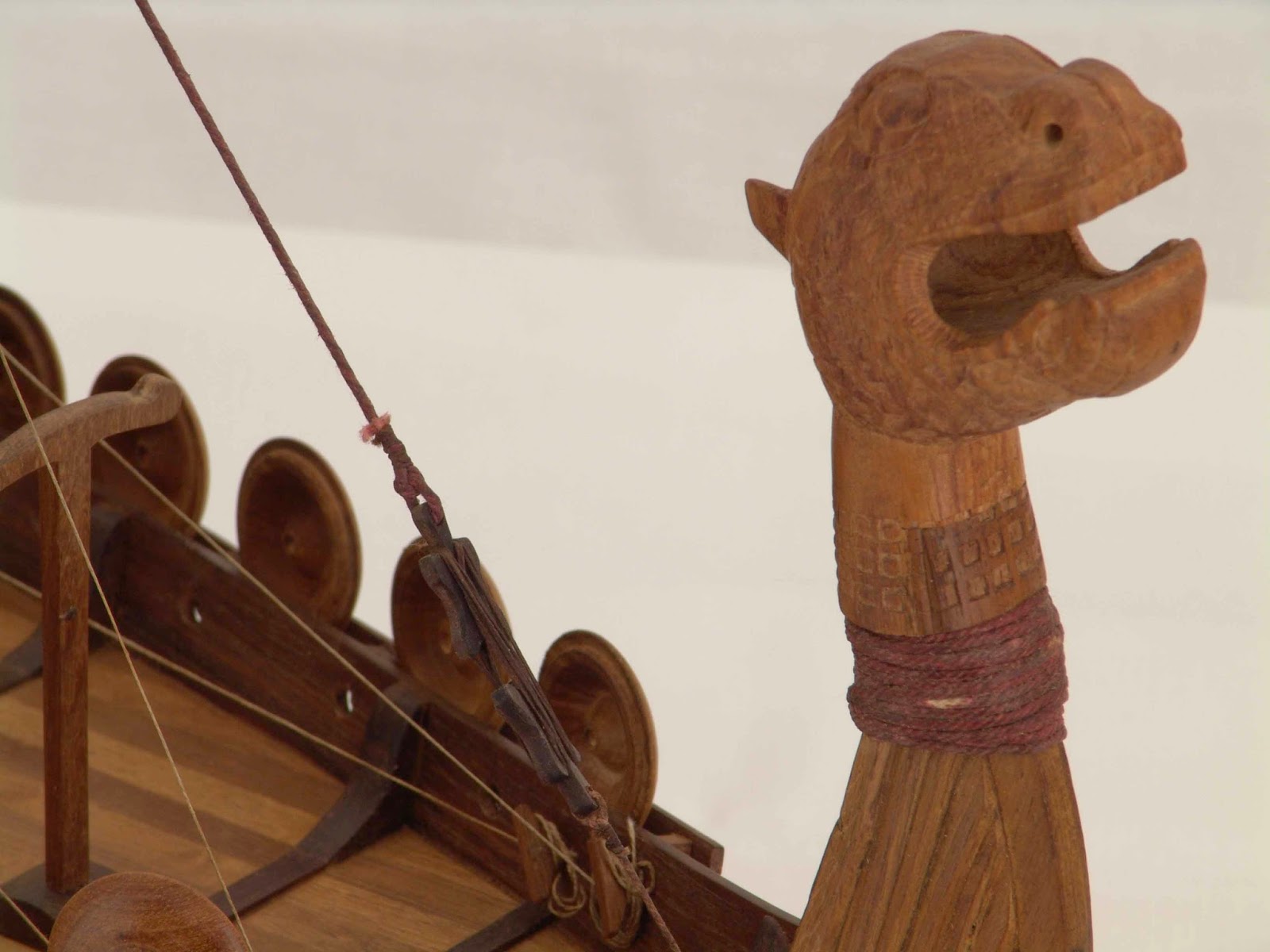
carvings of menacing beasts, such as dragons and snakes, allegedly to
protect the ship and crew, and to ward off the terrible sea monsters of
Norse mythology. It is however likely that the carvings, like those on
the Oseberg ship, might have had a ritual purpose, or that the purported
effect was to frighten enemies and townspeople. No true dragon ship, as
defined by the sagas, has been found by archaeological excavation.
► Drekar are known from historical sources, such as the 13th century
Göngu-Hrólfs Saga (the Saga of Rollo). Here, the ships are described as
elegant and ornately decorated, and used by those who went raiding and
plundering. According to the historical sources the ships' prows carried
carvings of menacing beasts, such as dragons and snakes, allegedly to
protect the ship and crew, and to ward off the terrible sea monsters of
Norse mythology. It is however likely that the carvings, like those on
the Oseberg ship, might have had a ritual purpose, or that the purported
effect was to frighten enemies and townspeople. No true dragon ship, as
defined by the sagas, has been found by archaeological excavation.Busse
► Busse ships were large longships, capable of carrying more cargo and passengers than Skei ships. The Ormen Lange is an example of a Busse Ship. It was the most famous ship of King Olaf Tryggvason. It is believed to be 45 metres (148 ft) long with 34 rowing positions.
Recent discovery
► On September 10, 2007, Professor Stephen Harding, University of Nottingham, used ground penetrating radar (GPR) equipment to pinpoint the location of a 1,000-year-old Viking transport longship (Nordic clinker design) beneath 6–10 feet (2–3 meters) of clay in Meols, Wirral, (a well-known settling place of Vikings). The ship had been previously uncovered in 1938 during excavation of a car park. Workers at the time covered the ship over again so as not to delay construction.
Construction

►The first true longship, that was rowed was the Nydam ship built in Denmark around 350 AD. It also had very rounded underwater sections but had more pronounced flair in the topsides, giving it more stability as well as keeping more water out of the boat at speed or in waves. It had no sail. It was of lapstrake construction fastened with iron nails. The bow and stern had slight elevation. The keel was a flattened plank about twice as thick as a normal strake plank but still not strong enough to withstand the downwards thrust of a mast.

► The first longships can trace their origin back to between 500 and 300 BC, when the Danish Hjortspring boat was built.[10] It was fastened with cord, not nailed, and paddled, not rowed. It had rounded cross sections and although 20 m (65 feet) long was only 2 m (6 feet) wide. The rounded sections gave maximum displacement for the lowest wetted surface area, similar to a modern narrow rowing skiff, so were very fast but had little carrying capacity. The shape suggests mainly river use. Unlike later boats, it had a low bow and stern. A distinctive feature is the two-prong cutaway bow section.
►The first true longship, that was rowed was the Nydam ship built in Denmark around 350 AD. It also had very rounded underwater sections but had more pronounced flair in the topsides, giving it more stability as well as keeping more water out of the boat at speed or in waves. It had no sail. It was of lapstrake construction fastened with iron nails. The bow and stern had slight elevation. The keel was a flattened plank about twice as thick as a normal strake plank but still not strong enough to withstand the downwards thrust of a mast.
 |
| The Stora Hammars I stone showing armed warriors in a longship. |
►Sails started to be used from possibly the 8th century. The earliest had either plaited or chequered pattern, with narrow strips sewn together.
►About 700 AD the Kvalslund ship was built. It is the first with a true keel. Its cross sectional shape was flatter on the bottom with less flair to the topsides. This shape is far more stable and able to handle rougher seas. It had the high prow of the later longships. After several centuries of evolution, the fully developed longship emerged some time in the middle of the ninth century. Its long, graceful, menacing head figure carved in the stern, such as the Oseburg ship, echoed the designs of its predecessors. The mast was now square in section and located toward the middle of the ship, and could be lowered and raised. The hull’s sides were fastened together to allow it to flex with the waves, combining lightness and ease of handling on land. The ships were large enough to carry cargo and passengers on long ocean voyages, but still maintained speed and agility, making the longship a versatile warship and cargo carrier.
Keel, stems and hull
 |
| Schematic drawing of a longship construction. |
►The Viking shipbuilders had no written diagrams or standard written design plan. The shipbuilder pictured the longship before its construction, based on previous builds, and the ship was then built from the keel up. The keel and stems were made first. The shape of the stem was based on segments of circles of varying sizes. The keel was an inverted T shape to accept the garboard planks. In the longships the keel was made up of several sections spliced together and fastened with treenails. The next step was building the strakes – the lines of planks joined endwise from stern to stern. Nearly all longships were clinker (also known as lapstrake) built, meaning that each hull plank overlapped the next. Each plank was hewn from an oak tree so that the finished plank was about 25 mm (0.98 inches) thick and tapered along each edge to a thickness of about 20 mm (0.79 inches). The planks were radially hewn so that the grain is approximately at right angles to the surface of the plank. This provides maximum strength, an even bend and an even rate of expansion and contraction in water. It modern terms this is called quarter sawn timber and has the least natural shrinkage of any cut section of wood. The plank above the turn of the bilge, the meginhufr, was about 37 mm (1.5 inches) thick on very long ships, but narrower to take the strain of the crossbeams. This was also the area subject to collisions. The planks overlapped by about 25 mm (0.98 inches)–30 mm (1.2 inches) and were joined by iron rivets. Each overlap was stuffed with wool or animal hair or sometimes hemp soaked in pine tar to ensure water tightness. At midlength, where the planks are straight, the rivets are about 170 mm (6.7 inches) apart but were closer together as the planks sweep up to the curved bow and stern. There is considerable twist and bend in the end planks. This was achieved by using both thinner (by 50%) and narrower planks. In more sophisticated builds, forward planks were cut from natural curved trees called reaction wood. Planks were installed unseasoned or wet. Partly worked stems and sterns have been located in bogs. It has been suggested they were stored there over winter to stop the wood drying and cracking. The moisture in wet planks allowed the builder to force the planks into a more acute bend if need be. Once dry it would stay in the forced position. At the bow and the stern builders were able to create hollow sections, or compound bends, at the waterline making the entry point very fine. In less sophisticated ships short and nearly straight planks were used at the bow and stern. Where long timber was not available, or the ship was very long, the planks were butt joined although over lapping scarf joints, fixed with nails were also used.
► As the planks reached the desired height, the interior frame (futtocks) and cross beams were added. Frames were placed close together which is an enduring feature of thin planked ships,still used today on some lightweight wooden racing craft such as those designed by Bruce Farr. Viking boat builders used a spacing of about 850 mm (33 inches). Part of the reason for this spacing was to achieve the correct distance between rowing stations and to create space for the chests used by Norse sailors as thwarts (seats). The bottom futtocks next to the keel were made from natural L-shaped crooks. The upper futtocks were usually not attached to the lower futtocks to allow some hull twist. The parts were held together with iron rivets, hammered in from the outside of the hull and fastened from the inside with a rove (washers). The surplus rivet was then cut off. A ship normally used about 700 kg (1,500 pounds) of iron nails in a 18 m (59 feet) long ship. In some ships the gap between the lower uneven futtock and the lapstrake planks was filled with a spacer block about 200 mm (7.9 inches) long. In later ships spruce stringers were fastened lengthwise to the futtocks roughly parallel to the keel. Longships had about five rivets for each yard (90 cm or 35 inches) of plank. In many early ships treenails (trenails, trunnels) were used to fasten large timbers. First, a hole about 20 mm (0.79 inches) wide hole was drilled through two adjoining timbers, a wooden pegs inserted which was split and a thin wedge inserted to expand the peg. Some treenails have been found with traces of linseed oil suggesting that treenails were soaked before the pegs were inserted. When dried the oil would act as a semi waterproof weak filler/glue.
► The longships’ narrow deep keel provided strength beneath the waterline. A typical size keel of a longer ship was 100 mm × 300 mm (3.9 by 11.8 inches) amidships, tapering in width at the bow and stern. Sometimes there was a false outer keel to take the wear while being dragged up a beach. These large timbers were shaped with both adze and broadaxe. At the bow the cut water was especially strong, as longboats sailed in ice strewn water in spring. Hulls up to 560 cm (18.4 feet) wide gave stability, making the longship less likely to tip when sailed. The greater beam provided more moment of leverage by placing the crew or any other mobile weight on the windward side. Oceangoing longships had higher topsides about a 1 m (3.3 feet) high to keep out water. Higher topsides were supported with knees with the long axis fastened to the top of the crossbeams. The hull was waterproofed with animal hair, wool, hemp or moss drenched in pine tar. In the autumn the ships would be tarred and then left in a boathouse over the winter to allow time for the tar to dry. To keep the sea out, wooden disks were put into the oar holes. These could be shut from the inside when the oars were not in use. A drain plug hole about 25 mm (0.98 inches) was drilled in the garboard plank on one side to allow rain water drainage.
► The oars did not use rowlocks or thole pins but square holes cut below the gunwale line. The holes were also used for belaying mooring lines and sail sheets. At the bow the forward upper futtock protruded about 400 mm (16 inches) above the sheerline and was carved to retain anchor or mooring lines.
► As the planks reached the desired height, the interior frame (futtocks) and cross beams were added. Frames were placed close together which is an enduring feature of thin planked ships,still used today on some lightweight wooden racing craft such as those designed by Bruce Farr. Viking boat builders used a spacing of about 850 mm (33 inches). Part of the reason for this spacing was to achieve the correct distance between rowing stations and to create space for the chests used by Norse sailors as thwarts (seats). The bottom futtocks next to the keel were made from natural L-shaped crooks. The upper futtocks were usually not attached to the lower futtocks to allow some hull twist. The parts were held together with iron rivets, hammered in from the outside of the hull and fastened from the inside with a rove (washers). The surplus rivet was then cut off. A ship normally used about 700 kg (1,500 pounds) of iron nails in a 18 m (59 feet) long ship. In some ships the gap between the lower uneven futtock and the lapstrake planks was filled with a spacer block about 200 mm (7.9 inches) long. In later ships spruce stringers were fastened lengthwise to the futtocks roughly parallel to the keel. Longships had about five rivets for each yard (90 cm or 35 inches) of plank. In many early ships treenails (trenails, trunnels) were used to fasten large timbers. First, a hole about 20 mm (0.79 inches) wide hole was drilled through two adjoining timbers, a wooden pegs inserted which was split and a thin wedge inserted to expand the peg. Some treenails have been found with traces of linseed oil suggesting that treenails were soaked before the pegs were inserted. When dried the oil would act as a semi waterproof weak filler/glue.
► The longships’ narrow deep keel provided strength beneath the waterline. A typical size keel of a longer ship was 100 mm × 300 mm (3.9 by 11.8 inches) amidships, tapering in width at the bow and stern. Sometimes there was a false outer keel to take the wear while being dragged up a beach. These large timbers were shaped with both adze and broadaxe. At the bow the cut water was especially strong, as longboats sailed in ice strewn water in spring. Hulls up to 560 cm (18.4 feet) wide gave stability, making the longship less likely to tip when sailed. The greater beam provided more moment of leverage by placing the crew or any other mobile weight on the windward side. Oceangoing longships had higher topsides about a 1 m (3.3 feet) high to keep out water. Higher topsides were supported with knees with the long axis fastened to the top of the crossbeams. The hull was waterproofed with animal hair, wool, hemp or moss drenched in pine tar. In the autumn the ships would be tarred and then left in a boathouse over the winter to allow time for the tar to dry. To keep the sea out, wooden disks were put into the oar holes. These could be shut from the inside when the oars were not in use. A drain plug hole about 25 mm (0.98 inches) was drilled in the garboard plank on one side to allow rain water drainage.
► The oars did not use rowlocks or thole pins but square holes cut below the gunwale line. The holes were also used for belaying mooring lines and sail sheets. At the bow the forward upper futtock protruded about 400 mm (16 inches) above the sheerline and was carved to retain anchor or mooring lines.
Sail and mast
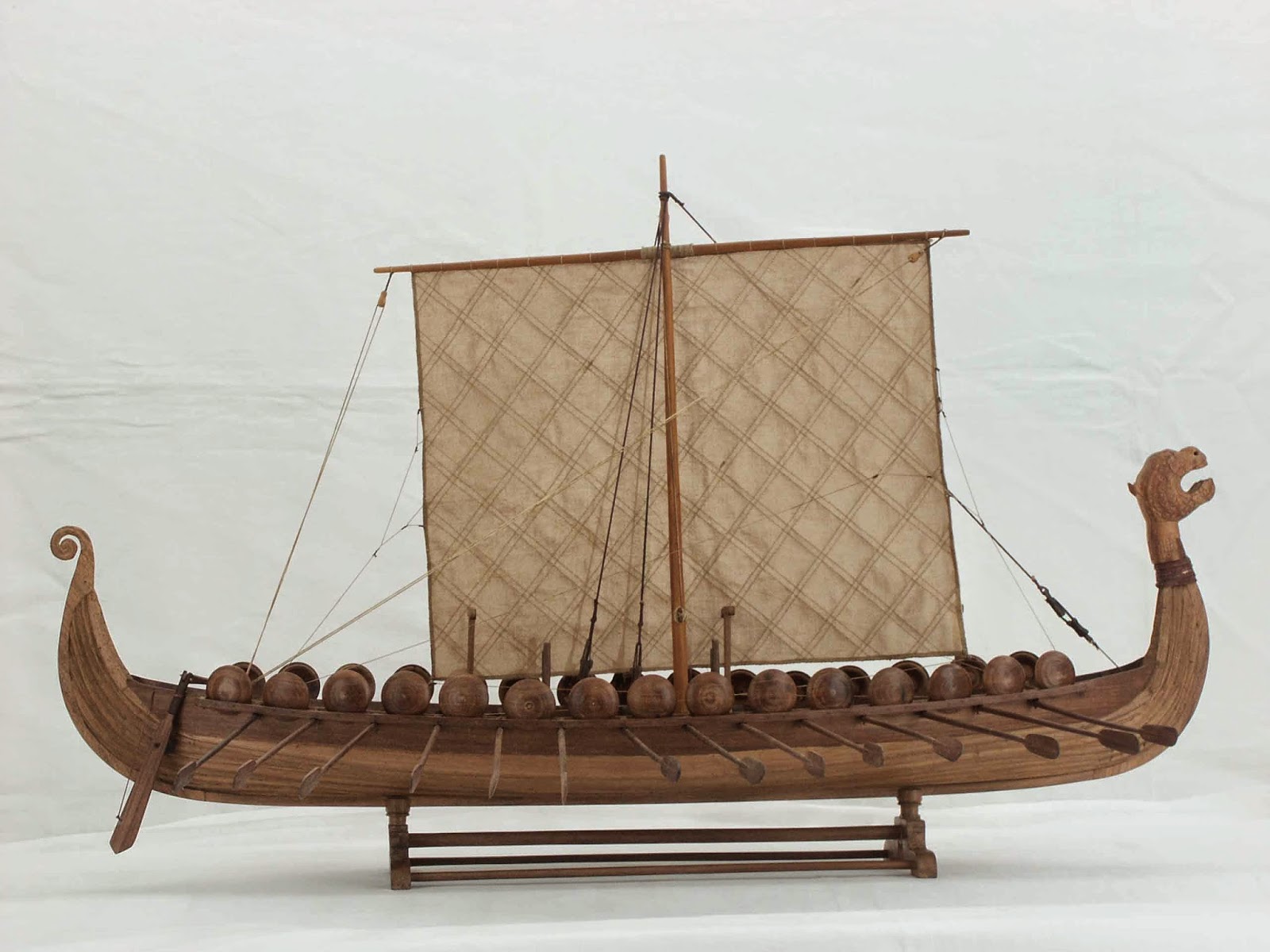
► Even though no longship sail has been found, accounts verify that longships had square sails. Sails measured perhaps 11 m (35 feet) to 12 m (40 feet) across, and were made of rough wool cloth. Unlike in knarrs, a longship sail was not stitched.
► The sail was held in place by the mast which was up to 16 m (52 feet) tall. Its base was about 250 mm × 180 mm (9.8 by 7.1 inches). The mast was supported by a large wooden maststep called a kerling ("Old Woman" in Old Norse) that was semicircular in shape. (Trent) The kerling was made of oak, and about 700 mm (28 inches) wide and up to 6 m (20 feet) long in the larger ships. It usually heavily tapered into a joint with the internal keelson, although keelsons were by no means universal. The kerling lay across two strong frames that ran width-wise above the keel in the centre of the boat. The kerling also had a companion: the "mast fish," a wooden timber above the kerling just below deck height that provided extra help in keeping the mast erect. It was a large wooden bulk of timber about 3 m (9.8 feet) long with a 1.4-metre long (4.6 ft) slot, facing aft to accommodate the mast as it was raised. This acted as a mechanism to catch and secure the mast before the stays were secured. It was an early form of mast partner but was aligned fore and aft. In later longships there is no mast fish-the mast partner is an athwartwise beam similar to more modern construction. Most masts were about half the length of the ship so that it did not project beyond the hull when unstepped. When lowered the mast foot was kept in the base of the mast step and the top of the mast secured in a natural wooden crook about 1.5–2.5 m (4 feet 11 inches–8 feet 2 inches) high, on the port side, so that it did not interfere with steering on the starboard side.
► There is a suggestion that the rig was sometimes used in a lateen style with the top cross spar dipped at an angle to aid sailing to windward i.e. the spar became the luff. There is little or no evidence to support this theory. No explanation is offered as to how this could be accomplished with a square sail as the lower reefed portion of the sail would be very bulky and would prevent even an approximation of the laminar flow necessary for windward sailing. There is no evidence of any triangular sails in use. Masts were held erect by side stays and possibly fore and aft stays. Each side stay was fitted at it lower end with a 150-millimetre long (5.9 in) toggle. There were no chain plates. The lower part of the side stay consisted of ropes looped under the end of a knee of upper futtock which had a hole underneath. The lower part of the stay was about 500–800 mm (1.6–2.6 feet) long and attached to a combined flat wooden turnblock and multi V jamb cleat called an angel (maiden, virgin). About 4 turns of rope went between the angel and the toggle to give the mechanical advantage to tighten the side stays. At each turn the v shape at the bottom of the angels "wings" jambed the stay preventing slippage and movement.
► The sail was held in place by the mast which was up to 16 m (52 feet) tall. Its base was about 250 mm × 180 mm (9.8 by 7.1 inches). The mast was supported by a large wooden maststep called a kerling ("Old Woman" in Old Norse) that was semicircular in shape. (Trent) The kerling was made of oak, and about 700 mm (28 inches) wide and up to 6 m (20 feet) long in the larger ships. It usually heavily tapered into a joint with the internal keelson, although keelsons were by no means universal. The kerling lay across two strong frames that ran width-wise above the keel in the centre of the boat. The kerling also had a companion: the "mast fish," a wooden timber above the kerling just below deck height that provided extra help in keeping the mast erect. It was a large wooden bulk of timber about 3 m (9.8 feet) long with a 1.4-metre long (4.6 ft) slot, facing aft to accommodate the mast as it was raised. This acted as a mechanism to catch and secure the mast before the stays were secured. It was an early form of mast partner but was aligned fore and aft. In later longships there is no mast fish-the mast partner is an athwartwise beam similar to more modern construction. Most masts were about half the length of the ship so that it did not project beyond the hull when unstepped. When lowered the mast foot was kept in the base of the mast step and the top of the mast secured in a natural wooden crook about 1.5–2.5 m (4 feet 11 inches–8 feet 2 inches) high, on the port side, so that it did not interfere with steering on the starboard side.
► There is a suggestion that the rig was sometimes used in a lateen style with the top cross spar dipped at an angle to aid sailing to windward i.e. the spar became the luff. There is little or no evidence to support this theory. No explanation is offered as to how this could be accomplished with a square sail as the lower reefed portion of the sail would be very bulky and would prevent even an approximation of the laminar flow necessary for windward sailing. There is no evidence of any triangular sails in use. Masts were held erect by side stays and possibly fore and aft stays. Each side stay was fitted at it lower end with a 150-millimetre long (5.9 in) toggle. There were no chain plates. The lower part of the side stay consisted of ropes looped under the end of a knee of upper futtock which had a hole underneath. The lower part of the stay was about 500–800 mm (1.6–2.6 feet) long and attached to a combined flat wooden turnblock and multi V jamb cleat called an angel (maiden, virgin). About 4 turns of rope went between the angel and the toggle to give the mechanical advantage to tighten the side stays. At each turn the v shape at the bottom of the angels "wings" jambed the stay preventing slippage and movement.
Rudder
 ► Early long boats used some form of steering oar but by the 10th century the side rudder (called a steerboard, which is why that side of the vessel is now called starboard) was well established. It consisted of a length of timber about 2.4 m (7 feet 10 inches) long. The upper section was rounded to a diameter of about 150 mm (5.9 inches). The lower blade was about 1.8 m × 0.4 m (5 feet 11 inches by 1 foot 4 inches). Since there is only a single steerboard, drag from that would make the ship steer a point or too to that side, so the shipwrights created a hydrofoil. ust like an airfoil, movement through fluid creates lift, which perfectly compensates for the offset drag. The steerboard on the Gokstad ship in the Viking Ship Museum in Oslo, Norway, is about 20 cm (8 inches) wide, completely flat inboard and with about a 7.6 cm (3 inches) maximum width at the center of the foil. The head of the rudder shaft had two square holes about 200–300 mm (7.9–11.8 inches) apart. When the rudder was in its normal position the tiller was inserted in the upper hole so that the tiller faced athwartwise. The shaft was attached to the gunwale by a U shaped joint. Near the stern, about halfway down the starboard topsides, was a rounded wooden block about 150 mm (5.9 inches) in diameter and 100 mm (3.9 inches) high, with a central hole for a rope. This corresponded to a hole in the midsection of the rudder blade. From the outside the rope ran through the blade, through the round block and topsides and was fastened inside the hull. The flexibility of the hemp rope allowed the blade to pivot. When beached or in shallow water the tiller was moved to the lower hole, the blade rope was slackened and the rudder head pulled up so the rudder could operate in shallow waters. Modern facsimiles are reported to steer quite well but require a very large amount of physical effort compared to the modern fore and aft tiller.
 Anchors

Ship builders toolkit
► At the height of Viking expansion into Dublin and Jorvik 875–954 AD the longship reached a peak of development such as the Gokstad ship 890. Archaeological discoveries from this period at Coppergate, York, show the shipwright had a large range of sophisticated woodwork tools. As well as the heavy adze, broad axe, wooden mallets and wedges, the craftsman had steel tools such as anvils, files, snips, awls, augers, gouges, draw knife, knives, including folding knives, chisels and small 300 mm (12 inches) long bow saws with antler handles. Edged tools were kept sharp with sharpening stones from Norway. One of the most sophisticated tools was a 25 mm (0.98 inches) diameter twist drill bit, perfect for drilling hole for treenails. Simple mechanical pole wood lathes were used to make cups and bowls.
Replica longships
► Since the discovery of the original longships in the 1800s, many boat builders have built many Viking ship replicas. However, most have not been able to resist the temptation to use more modern techniques and tools in construction. In 1892–93 a full-size near-replica of the Gokstad ship, the Viking, was built by the Norwegian Magnus Andersen in Bergen. It was used to sail the Atlantic. It had a deeper keel with 1.5 m (4 feet 11 inches) draught to stiffen the hull and a range of non-authentic triangular sails to help performance and big fenders on each gunwale filled with reindeer hair to give extra buoyancy in case of swamping. The skipper recorded that the keel bowed upwards as much as 20 mm (0.79 inches) and the gunwale flexed inwards as much as 150 mm (5.9 inches) in heavy seas.[12] A half-size replica of the Sutton Hoo longship has been equipped with a substantial sail, despite the original having oar power only.
Navigation and propulsion
Navigation
 ► The Vikings were experts in judging speed and wind direction, and in
knowing the current and when to expect high and low tides. Viking
navigational techniques are not well understood, but historians
postulate that the Vikings probably had some sort of primitive astrolabe
and used the stars to plot their course.
► The Vikings were experts in judging speed and wind direction, and in
knowing the current and when to expect high and low tides. Viking
navigational techniques are not well understood, but historians
postulate that the Vikings probably had some sort of primitive astrolabe
and used the stars to plot their course.
► The Danish archaeologist Thorkild Ramskou suggested in 1967 that the
"sun-stones" referred to in some sagas might have been natural crystals
capable of polarizing skylight. The mineral cordierite occurring in
Norway has the local name "Viking's Compass." Its changes in colour
would allow determining the sun's position (azimuth) even through an
overcast or foggy horizon. See here.
► An ingenious navigation method is detailed in Viking Navigation Using
the Sunstone, Polarized Light and the Horizon Board by Leif K. Karlsen.
To derive a course to steer relative to the sun direction, he uses a
sun-stone (Solarsteinn) made of Iceland spar (optical calcite or
Silfurberg), and a "horizon-board." The author constructed the latter
from an Icelandic saga source, and describes an experiment performed to
determine its accuracy. Karlsen also discusses why on North Atlantic
trips the Vikings might have preferred to navigate by the sun rather
than by stars. (Think high latitudes in summer: long days, short to no
nights.)
► A Viking named Stjerner Oddi compiled a chart showing the direction
of sunrise and sunset, which enabled navigators to sail longships from
place to place with ease. Almgren, an earlier Viking, told of another
method: "All the measurements of angles were made with what was called a
'half wheel' (a kind of half sun-diameter which corresponds to about
sixteen minutes of arc). This was something that was known to every
skipper at that time, or to the long-voyage pilot or kendtmand ('man who
knows the way') who sometimes went along on voyages... When the sun was
in the sky, it was not, therefore, difficult to find the four points of
the compass, and determining latitude did not cause any problems
either." (Algrem)
► Birds provided a helpful guide to finding land. A Viking legend
states that Vikings used to take caged crows aboard ships and let them
loose if they got lost. The crows would instinctively head for land,
giving the sailors a course to steer. Little is known about viking
compasses, but remains have been found of viking sun compasses. which
use the direction of the sun to find which direction is North.
Propulsion
► The longships had two methods of propulsion: oars and sail. At sea,
the sail enabled longships to travel faster than by oar and to cover
long distances overseas. Sails could be raised or lowered quickly. Oars
were used when near the coast or in a river, to gain speed quickly, and
when there was an adverse (or insufficient) wind. In combat, the
variability of wind power made rowing the chief means of propulsion.
► Longships were not fitted with benches. When rowing, the crew sat on
sea chests (chests containing their personal possessions) that would
otherwise take up space. The chests were made the same size and were the
perfect height for a Viking to sit on and row. Longships had hooks for
oars to fit into, but smaller oars were also used, with crooks or bends
to be used as oarlocks. If there were no holes then a loop of rope kept
the oars in place.
► An innovation that improved the sail's performance was the beitass,
or stretching pole – a wooden spar stiffening the sail.
Legacy
► The Vikings were major contributors to the shipbuilding technology of
their day. Their shipbuilding methods spread through extensive contact
with other cultures, and ships from the 11th and 12th centuries are
known to borrow many of the longships’ design features, despite the
passing of many centuries. The 'Lancha Poveira,' a boat from Póvoa de
Varzim, Portugal is one of the last remnants from the longship, keeping
all the longboat features but without a long stern and bow, and with a
Mediterranean sail. It was used until the 1950s. Today there is just one
boat: Fé em Deus.
► Many historians, archaeologists and adventurers have reconstructed
longships in an attempt to understand how they worked. These re-creators
have been able to identify many of the advances that the Vikings
implemented in order to make the longship a superior vessel. One replica
longship covered 223 nautical miles (413 km) in a single day, and
another re-creator was able to go faster than 8 knots (15 km/h) in his
longship.
► The longship was a master of all trades. It was wide and stable, yet
light, fast, and nimble. With all these qualities combined in one ship,
the longship was unrivaled for centuries, until the arrival of the great
Cog.
 |
| Image from the Bayeux Tapestry showing Harold Godwinson's ship approaching a beach, probably in the Somme Estuary |
► In Scandinavia, the longship was the usual vessel for war even with
the introduction of cogs in the 12th–13th centuries. Leidang fleet-levy
laws remained in place for most of the Middle Ages, demanding that the
freemen should build, man and furnish ships for war if demanded by the
king—ships with at least 20 or 25 oar-pairs (40–50+ rowers). However, by
the late 14th century, these low-boarded vessels were at a disadvantage
against newer, taller vessels – when the Victual Brothers, in the
employee of the Hansa, attacked Bergen in the autumn of 1393, the "great
ships" of the pirates could not be boarded by the Norwegian levy ships
called out by Margaret I of Denmark and the raiders were able to sack
the town with impunity. While earlier times had seen larger and taller
longships in service, by this time the authorities had also gone over to
other types of ships for warfare. The last Viking longship was defeated
in 1429.
Model
 |
 |
 |
 |
 |
 |
 |
 |
 |
 |
 |
 |
 |
 |
 |
 |
 |
 |
 |
 |
 |
|
 |
 |

Ship Plans


