Go to Blogger edit html and find these sentences.Now replace these sentences with your own descriptions.This theme is Bloggerized by Lasantha Bandara - Premiumbloggertemplates.com.
Go to Blogger edit html and find these sentences.Now replace these sentences with your own descriptions.This theme is Bloggerized by Lasantha Bandara - Premiumbloggertemplates.com.
Go to Blogger edit html and find these sentences.Now replace these sentences with your own descriptions.This theme is Bloggerized by Lasantha Bandara - Premiumbloggertemplates.com.
Go to Blogger edit html and find these sentences.Now replace these sentences with your own descriptions.This theme is Bloggerized by Lasantha Bandara - Premiumbloggertemplates.com.
Go to Blogger edit html and find these sentences.Now replace these sentences with your own descriptions.This theme is Bloggerized by Lasantha Bandara - Premiumbloggertemplates.com.
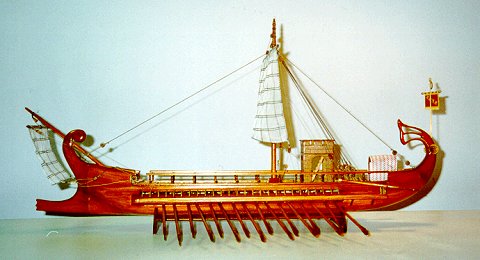
A bireme is an ancient Hellenistic-era warship with two decks of oars, probably invented by the Phoenicians. It typically was about 80 feet (24 m) long with a maximum beam length of around 10 feet (3.0 m). It was modified from penteconters (a ship that had only one set of oars on each side) but the bireme had two sets of oars on each side. The bireme was twice the triaconter's length and height, and thus employing 120 rowers, while the trireme, keeping the length of the bireme, added a tier to the height, the rowers being thus increased to 180. It also had a large square sail. This ship was also used by the Romans frequently and were used during the second of Caesar's invasions of Britain. It evolved into the trireme. Often there would be a group of marines and a unit commandant (the commandant was given a tent on the open deck). We first find it recorded in ancient history on 8th century Assyrian reliefs. The name bireme comes from "bi-" meaning two and "-reme" meaning oar.
Medieval galleys are spoken of as being "bireme" or "trireme"; This Greek bireme, with its shallow hull and lofty, open super-structure, could hardy have been a seaworthy vessel. This terminology can lead to some confusion, since the terms are also used for rowed warships of the Greco-Roman period built on entirely different design principles. In 1275 Charles of Anjou king of Sicily, issued an order for the construction of several galleys that now provides the earliest evidence for the dimensions of these bireme galleys. Because of increased weight and breadth, which brought increased friction through the water, a trireme galley wouldn't have been dramatically faster than a bireme. However, the change from bireme to trireme produced even more significant developments than a gain in tactical speed over short distances. Early bireme galleys escorted merchant ships but were only rarely used to carry goods themselves. There are a few Genoese freight contracts of the mid-thirteenth century that record charters for bireme galleys.
USS Constitution is a wooden-hulled, three-masted heavy frigate of the United States Navy.by President George Washington after the Constitution of the United States of America, she is the world's oldest floating commissioned naval vessel.Launched in 1797, Constitution was one of six original frigates authorized for constructionby the Naval Act of 1794. Joshua Humphreys designed the frigates to be the young Navy's capital ships, and so Constitution and her sisters were larger and more heavily armed and built than standard frigates of the period. Built in Boston, Massachusetts at EdmundHartt's shipyard, her first duties with the newly formed United States Navy were to provideprotection for American merchant shipping during the Quasi-War with France and to defeatthe Barbary pirates in the First Barbary War.
Constitution is most famous for her actions during the War of 1812 against Great Britain, when she captured numerous merchant ships and defeated five British warships: HMS Guerriere, Java, Pictou, Cyane and Levant. The battle with Guerriere earned her the nickname of "Old Ironsides" and public adoration that has repeatedly saved her from scrapping. She continued to actively serve the nation as flagship in the Mediterranean and African squadrons, and circled the world in the 1840s. During the American Civil War she served as a training ship for the United States Naval Academy and carried artwork and industrial displays to the Paris Exposition of 1878. Retired from active service in 1881, she served as a receiving ship until designated a museum ship in 1907. In 1931 she started a three year 90-port tour of the nation, and in 1997 she finally sailed again under her own power for her 200th birthday.
Constitution's mission today is to promote understanding of the Navy’s role in war and peace through educational outreach, historic demonstration, and active participation in public events. As a fully commissioned US Navy ship, her crew of 60 officers and sailors participate in ceremonies, educational programs and special events while keeping the ship open to visitors year-round and providing free tours. The officers and crew are all active-duty US Navy personnel and the assignment is considered special duty in the Navy. Traditionally, command of the vessel is assigned to a Navy Commander. She is berthed at Pier 1 of the former Charlestown Navy Yard, at one end of Boston's Freedom Trail.
Construction
The Naval Act of 1794 provided for the construction of four ships carrying forty-four guns each, and two ships carrying thirty-six guns each. Constitution was the second of the forty-four gun frigates to be completed, and was given her name by President George Washington. Her keel was laid down on 1 November 1794 at Edmund Hartt's shipyard in Boston, Massachusetts, under the supervision of Captain Samuel Nicholson and naval constructor George Claghorn.
Primary materials used in her construction were white pine, longleaf pine, white oak, and, most importantly, southern live oak, which was cut and milled at Gascoigne Bluff in St. Simons, Georgia. Southern live oak, a particularly dense wood, can weigh up to 75 lb (34 kg) per cubic foot (1,201 kg/m3). Constitution's hull was built 21 inches (530 mm) thick in an era when 18 inches (460 mm) was common. Her length between perpendiculars was 175 ft (53 m), with a 204 ft (62 m) length overall and a width of 43 ft 6 in (13.26 m). In total, 60 acres (24 ha) of trees were needed for her construction. Paul Revere forged the copper bolts and breasthooks. The copper sheathing, installed to prevent shipworm, was imported from England.
In March 1796, as construction slowly progressed, a peace accord was announced between the United States and Algiers and, in accordance with the Naval Act of 1794, construction was halted. After some debate and prompting by President Washington, Congress agreed to continue to fund the construction of the three ships nearest to completion: United States, Constellation and Constitution.
Her launching ceremony on 20 September 1797 was attended by then President John Adams and Massachusetts Governor Increase Sumner. Upon launch, she only slid down the ways 27 feet (8.2 m) before stopping. Her weight caused the ways to settle into the ground, preventing further movement. An attempt two days later only resulted in an additional 31 feet (9.4 m) of travel before the ship again stopped. After a month of rebuilding the ways, Constitution finally slipped into Boston Harbor on 21 October 1797 with Captain James Sever breaking a bottle of Madeira wine on her bowsprit.
Armament
Though rated as a 44-gun frigate, Constitution would often carry over 50 guns at a time. Ships of this era had no permanent battery of guns as modern Navy ships carry. The guns and cannons were designed to be completely portable and often were exchanged between ships as situations warranted. Each commanding officer outfitted armaments to their liking, taking into consideration factors such as the overall tonnage of cargo, complement of personnel aboard, and planned routes to be sailed. Consequently, the armaments on ships would change often during their careers, and records of the changes were not generally kept.
During the War of 1812, Constitution's battery of guns typically consisted of thirty 24-pounder (11 kg) cannons, divided to 15 on each side of the gun deck. Twenty-two 32-pounder (15 kg) carronades on the spar deck were divided to 11 on each side. Four chase guns would also be positioned, two each at the stern and bow.
Since her 1927–31 restoration all of the guns aboard Constitution are replicas. Most were cast in 1930, but two carronades on the spar deck were cast in 1983. In order to restore the capability of firing ceremonial salutes, during her 1973–76 restoration, a modern 40 mm saluting gun was hidden inside the forward long guns on each side.
Quasi-War
Near the end of her fitting out period, Nicholson was authorized to recruit sailors and midshipmen to serve in Constitution, but met with a lack of interest from potential recruits. The Naval Agent at Boston attributed the difficulties to Nicholson's character, describing him as "a rough, blustering tar merely, a man whose noise and vanity is disgusting to the sailors".
President Adams ordered all Navy ships to sea in late May to patrol for armed ships of France, and to free any American ship captured by them. Constitution was still not ready to sail, and eventually had to borrow sixteen 18-pound cannons from Castle Island before finally being readied. Constitution put to sea on the evening of 22 July 1798 with orders to patrol the Eastern Seaboard between New Hampshire and New York. A month later she was patrolling between Chesapeake Bay and Savannah, Georgia when Nicholson found his first opportunity for capturing a prize: off the coast of Charleston, South Carolina, on 8 September, she intercepted Niger, a 24-gun ship sailing with a French crew en route from Jamaica to Philadelphia, claiming to have been under the orders of Great Britain. Perhaps not understanding his orders correctly, Nicholson had the crewmen imprisoned, placed a prize crew aboard Niger, and brought her into Norfolk, Virginia. Constitution sailed south again a week later to escort a merchant convoy, but her bowsprit was severely damaged in a gale; she returned to Boston for repairs. In the meantime, Secretary of the Navy Benjamin Stoddert determined Niger was operating under the orders of Great Britain as claimed, and the ship and her crew were released to continue their voyage. The American government paid a restitution of $11,000 to Great Britain.
After departing from Boston on 29 December, Nicholson reported to Commodore John Barry near the island of Dominica for patrols in the West Indies. On 15 January 1799 Constitution intercepted the English merchantman Spencer, which had been taken prize by the French frigate L'Insurgente a few days prior. Technically, Spencer was a French ship operated by a French prize crew; but Nicholson, perhaps hesitant after the affair with Niger, released the ship and her crew the next morning. Joining Barry's command from United States, Constitution almost immediately had to put in for repairs to her rigging due to storm damage, and it was not until 1 March that anything of note occurred. On this date, she encountered HMS Santa Margarita, the captain of which was an acquaintance of Nicholson. The two agreed to a sailing duel, which the English captain was confident he would win, but after 11 hours of sailing, Santa Margarita lowered her sails and admitted defeat, paying her reward of a cask of wine to Nicholson. Resuming her patrols, Constitution managed to recapture the American sloop Neutrality on 27 March and, a few days later, the French ship Carteret. Secretary Stoddert had other plans, however, and recalled Constitution to Boston. She arrived there on 14 May, and Nicholson was relieved of command.
Change of command
Captain Silas Talbot was recalled to duty for the command of Constitution as the Commodore of operations in the West Indies. After repairs and resupply were completed, Constitution departed Boston on 23 July with a destination of Saint-Domingue via Norfolk to interrupt French shipping. She took the prize Amelia from a French prize crew on 15 September and Talbot sent the ship back to New York City with an American prize crew. Constitution arrived at Saint-Domingue on 15 October and rendezvoused with Boston, General Greene and Norfolk. No further incidents occurred over the next six months as French hostilities in the area had declined. Constitution busied herself with routine patrols and Talbot made diplomatic visits. It was not until April 1800 that Talbot investigated an increase in ship traffic near Puerto Plata, Santo Domingo, and discovered the French privateer Sandwich had taken refuge there. On 8 May the squadron captured the sloop Sally and Talbot hatched a plan to capture Sandwich, utilizing the familiarity of Sally to allow the Americans access to the harbor. First Lieutenant Isaac Hull led 90 sailors and Marines into Puerto Plata without challenge on 11 May, capturing Sandwich and spiking the guns of the nearby Spanish fort. It was later determined that Sandwich had been captured from a neutral port; she was returned to the French with apologies, and no prize money was awarded to the squadron.
Routine patrols again occupied Constitution for the next two months, until 13 July when the mainmast trouble of a few months before returned. She put into Cap Francois for repairs. With the terms of enlistment soon to expire for the sailors aboard her, she made preparations for return to the United States, and was relieved from duty by Constellation on 23 July. Constitution escorted twelve merchantmen to Philadelphia on her return voyage, and put in on 24 August at Boston, where she received new masts, sails and rigging. Even though peace was imminent between the United States and France, Constitution again sailed for the West Indies on 17 December as squadron flagship, rendezvousing with Congress, Adams, Augusta, Richmond and Trumbull. Although no longer allowed to pursue French shipping, the squadron was assigned to protect American shipping and continued in that capacity until April 1801 when Herald arrived with orders for the squadron to return to the United States. Constitution returned to Boston where she lingered, finally being scheduled for an overhaul in October which was later canceled. She was placed in ordinary on 2 July 1802.
First Barbary War
During the United States' preoccupation with France and the Quasi-War, troubles with the Barbary States were suppressed by the payment of tribute to ensure that American merchant ships were not harassed and seized. In 1801 Yusuf Karamanli of Tripoli, dissatisfied with the amount of tribute he was receiving in comparison to Algiers, demanded an immediate payment of $250,000. In response, Thomas Jefferson sent a squadron of frigates to protect American merchant ships in the Mediterranean and to pursue peace with the Barbary States.
The first squadron, under the command of Richard Dale in President, was instructed to escort merchant ships through the Mediterranean and negotiate with leaders of the Barbary States. A second squadron was assembled under the command of Richard Valentine Morris in Chesapeake. The performance of Morris's squadron was so poor that he was recalled and subsequently dismissed from the Navy in 1803.
Captain Edward Preble recommissioned Constitution 13 May 1803 as his flagship, and made preparations to command a new squadron for a third blockade attempt. The copper sheathing on Constitution's hull needed to be replaced; this was the first of many times that Paul Revere supplied the copper sheets necessary for the job.
Constitution departed Boston on 14 August. On 6 September, near the Rock of Gibraltar, she encountered an unknown ship in the darkness. Constitution went to general quarters, then ran alongside of her. Preble hailed the unknown ship, only to receive a hail in return. After identifying as the United States frigate Constitution, he received the same question again. Preble, losing his patience, said: "I am now going to hail you for the last time. If a proper answer is not returned, I will fire a shot into you." The stranger returned, "If you give me a shot, I'll give you a broadside." Asking once more, Preble demanded an answer, to which he received, "This is His Britannic Majesty's ship Donegal, 84 guns, Sir Richard Strachan, an English commodore." as well as a command to "Send your boat on board." Preble, now devoid of all patience, exclaimed, "This is United States ship Constitution, 44 guns, Edward Preble, an American commodore, who will be damned before he sends his boat on board of any vessel." And then to his gun crews: "Blow your matches, boys!" Before the incident escalated further, a boat arrived from the ship and a British lieutenant relayed his Captain's apologies. The ship was in fact not Donegal but was HMS Maidstone, a 32-gun frigate. Constitution had come alongside her so quietly that Maidstone had delayed answering with the proper hail while readying her guns. This act began the strong allegiance between Preble and the officers under his command, known as "Preble's boys", as he had shown he was willing to defy a ship of the line.
Arriving at Gibraltar on 12 September, Preble waited for the other ships of the squadron. His first order of business was to arrange a treaty with Sultan Slimane of Morocco, who was holding American ships hostage to ensure the return of two vessels the Americans had captured. Departing Gibraltar on 3 October, Constitution and Nautilus arrived at Tangiers on the 4th. Adams and New York arrived the next day. With four American warships in his harbor, the Sultan was more than glad to arrange the transfer of ships between the two nations, and Preble departed with his squadron on 14 October, and headed back to Gibraltar.
Battle of Tripoli Harbor
On 31 October Philadelphia, under the command of William Bainbridge, ran aground off Tripoli while pursuing a Tripoline vessel. The crew were taken prisoner; Philadelphia was refloated by the Tripolines and brought into their harbor. To deprive the Tripolines of their new prize, Preble planned to scuttle Philadelphia using the captured ship Mastico, which was renamed Intrepid. Under the command of Stephen Decatur, Intrepid entered Tripoli Harbor on 16 February 1804 disguised as a merchant ship. Decatur's crew quickly overpowered the Tripoline crew and set Philadelphia ablaze
Withdrawing the squadron to Syracuse, Sicily, Preble began planning for a summer attack on Tripoli, procuring a number of smaller gunboats that could move in closer to Tripoli than was feasible with Constitution's deep draft. Arriving the morning of 3 August, Constitution, Argus, Enterprise, Scourge, Syren, the six gunboats, and two bomb ketches began operations. Twenty-two Tripoline gunboats met them in the harbor and, in a series of attacks in the coming month, Constitution and her squadron severely damaged or destroyed the Tripoline gunboats, taking their crews prisoner. Constitution primarily provided gunfire support—bombarding the shore batteries of Tripoli. Despite his losses, Karamanli remained firm in his demand for ransom and tribute.
In a last attempt of the season against Tripoli, Preble outfitted Intrepid as a "floating volcano" with 100 short tons (91 t) of gunpowder aboard. She was to sail into Tripoli harbor and blow up in the midst of the corsair fleet close under the walls of the city. Under the command of Richard Somers, Intrepid made her way into the harbor on the evening of 3 September but exploded prematurely, killing Somers and his entire crew of thirteen volunteers.
Constellation and President arrived at Tripoli on the 9th with Samuel Barron in command; Preble was forced to relinquish his command of the squadron to Barron, who was senior in rank. Constitution was ordered to Malta on the 11th for repairs, and while en route captured two Greek vessels attempting to deliver wheat into Tripoli. On the 12th, a collision with President severely damaged Constitution's bow, stern and figurehead of Hercules. The collision was attributed to an "Act of God" from a sudden change in wind direction
Battle of Derne
Captain John Rodgers assumed command of Constitution on 9 November while she underwent repairs and resupply in Malta, and resumed the blockade of Tripoli on 5 April 1805, capturing a Tripoline xebec and the two prizes she had captured. Meanwhile, Commodore Barron gave William Eaton naval support to bombard Derne, while a detachment of US Marines under the command of Presley O’Bannon were assembled to attack the city by land. They captured it on 27 April. A peace treaty with Tripoli was signed aboard Constitution on 3 June, upon which she embarked the crew of Philadelphia and returned them to Syracuse. Dispatched to Tunis, Constitution arrived there on 30 July and by 1 August seventeen additional American warships had gathered in its harbor: Congress, Constellation, Enterprise, Essex, Franklin, Hornet, John Adams, Nautilus, Syren, and eight gunboats. Negotiations went on for several days until a short-term blockade of the harbor finally produced a peace treaty on 14 August.
Rodgers remained in command of the squadron, tasked with sending warships back to the United States when they were no longer needed. Eventually all that remained were Constitution, Enterprise and Hornet. They performed routine patrols and observed the French and Royal Navy operations of the Napoleonic Wars. Rodgers turned command of the squadron and Constitution over to Captain Hugh G. Campbell on 29 May 1806.
James Barron and Chesapeake sailed out of Norfolk on 15 May 1807 to replace Constitution as the flagship of the Mediterranean squadron, but soon encountered HMS Leopard, resulting in the Chesapeake-Leopard Affair. Relief of Constitution was delayed. Constitution continued patrols, unaware of the delay. She arrived in late June at Leghorn, where she took aboard the disassembled Tripoli Monument for transport back to the United States. Arriving at Málaga, she learned the fate of Chesapeake. Campbell immediately began preparing Constitution and Hornet for possible war against England. The crew, upon learning of the delay in their relief, became mutinous and refused to sail any further unless the destination was the United States. Campbell and his officers threatened to fire a cannon full of grape shot at the crew if they did not comply, thereby putting an end to the conflict. Ordered home on 18 August, Campbell and the squadron set sail for Boston on 8 September, arriving there 14 October. Constitution had been gone over four years
War of 1812
Constitution was recommissioned in December with Captain John Rodgers again taking command to oversee a major refitting. She was overhauled at a cost just under $100,000; however, Rodgers inexplicably ignored cleaning her copper sheathing, later leading him to declare her a "slow sailer". She spent most of the following two years on training runs and ordinary duty. When Isaac Hull took command in June 1810, he immediately recognized that she needed her hull bottom cleaned. "Ten waggon loads" of barnacles and seaweed were removed.
Hull departed on 5 August 1811 for France, transporting the new Ambassador Joel Barlow and his family; they arrived on 1 September. Remaining near France and Holland through the winter months, Hull continually held sail and gun drills to keep the crew ready for possible hostilities with the British. After the events of the Little Belt Affair the previous May, tensions were high between the United States and Britain, and Constitution was shadowed by British frigates while awaiting dispatches from Barlow to carry back to the United States. They arrived home on 18 February 1812.
War was declared on 18 June and Hull put to sea on 12 July, attempting to join the five ships of a squadron under the command of Rodgers in President. Hull sighted five ships off Egg Harbor, New Jersey on 17 July and at first believed them to be Rodgers' squadron, but by the following morning the lookouts determined they were a British squadron out of Halifax—HMS Aeolus, Africa, Belvidera, Guerriere and Shannon. They had sighted Constitution and were giving chase.
Finding himself becalmed, Hull acted on a suggestion given by Charles Morris and ordered the crew to put boats over the side to tow the ship out of range, using kedge anchors to draw the ship forward, and wetting the sails down to take advantage of every breath of wind. The British ships soon imitated the tactic of kedging and remained in pursuit. The resulting 57 hour chase in the July heat saw the crew of Constitution employ a myriad of methods to outrun the squadron, finally pumping overboard 2,300 U.S. gal (8.7 kl) of drinking water. Cannon fire was exchanged several times, though the British attempts fell short or over their mark, including an attempted broadside from Belvidera. On 19 July Constitution pulled far enough ahead of the British squadron that they abandoned the pursuit.
Constitution arrived in Boston on 27 July and remained there just long enough to replenish her supplies; Hull sailed without orders on 2 August to avoid being blockaded in port. Heading on a northeast route towards the British shipping lanes near Halifax and the Gulf of Saint Lawrence, Constitution captured three British merchantmen, which Hull ordered burned rather than risk taking them back to an American port. On 16 August Hull was informed of the presence of a British frigate 100 nmi (190 km; 120 mi) to the south and sailed in pursuit.
Constitution vs Guerriere
A frigate sighted on 19 August was determined to be HMS Guerriere, with the words "Not The Little Belt" painted on one of her topsails. Guerriere opened fire upon entering range of Constitution, but Hull held his ship's guns in check until the two warships were a mere 25 yards (23 m) apart, at which point he ordered a full double-loaded broadside of grape and round shot. Over the course of the engagement, the ships collided, and at one point they rotated together counter-clockwise while Constitution continued firing broadsides. Guerriere's bowsprit became entangled in Constitution's rigging. When the two ships pulled apart, the force of the extracting bowsprit sent shockwaves through Guerriere's rigging. Her foremast soon collapsed and it took the mainmast down with it shortly afterward. Guerriere was now a dismasted, unmanageable hulk, with close to a third of her crew wounded or killed, while Constitution remained largely intact. The British surrendered.
The battle left Guerriere so badly damaged that she was not worth towing to port. The next morning, after transferring the British prisoners onto the Constitution, Hull ordered Guerriere burned. Using his heavier broadsides and his ship's sailing ability, Hull had managed to surprise the British and to their astonishment, many of their shot rebounded harmlessly off Constitution's hull. A sailor reportedly exclaimed "Huzzah! her sides are made of iron!" and Constitution acquired the nickname "Old Ironsides". Arriving back in Boston on 30 August, Hull and his crew found that news of their victory had spread like wildfire, and they were hailed as heroes.
Constitution vs Java
On 8 September William Bainbridge, senior to Hull, took command of "Old Ironsides" and prepared her for another mission in British shipping lanes near Brazil. Sailing with Hornet on 27 October, they arrived near São Salvador on 13 December, sighting HMS Bonne Citoyenne in the harbor. Bonne Citoyenne reportedly was carrying $1,600,000 in currency to England, but her Captain refused to leave the neutral harbor lest he risk losing his cargo. Leaving Hornet to await the departure of Bonne Citoyenne, Constitution sailed offshore in search of prizes. On 29 December she met with HMS Java under Captain Henry Lambert, a frigate of the same class as the Guerriere, and at the initial hail from Bainbridge, Java answered with a broadside that severely damaged Constitution's rigging. She was able to recover, and returned a series of broadsides to Java. A shot from Java destroyed Constitution's helm (wheel), and Bainbridge, wounded twice during the battle, directed the crew to steer her manually from the tiller for the remainder of the engagement. Similar to the battle with Guerriere, Java's bowsprit became entangled in Constitution's rigging, allowing Bainbridge to continue raking her with broadsides. Her foremast collapsed, sending the fighting top crashing down two decks below.
Drawing off to make emergency repairs, Bainbridge re-approached Java an hour later. As had been the case with Guerriere, the Java lay in shambles, an unmanageable wreck with a badly wounded crew. The British ship surrendered. Determining that Java was far too damaged to retain as a prize, Bainbridge ordered her burned, but not before having her helm salvaged and installed on Constitution. On her return to São Salvador on 1 January 1813, she met with Hornet and that ship's two British prizes to disembark the prisoners of Java. Being far away from a friendly port and needing extensive repairs, Bainbridge ordered Constitution to sail for Boston on 5 January, leaving Hornet behind to continue waiting for Bonne Citoyenne in the hopes that she would leave the harbor (she did not). Her victory over Java, the third British warship in as many months to be captured by the United States, would prompt the British Admiralty to order their frigates not to engage the heavier American frigates one-on-one. Only British ships of the line or squadrons were permitted to come close enough to these ships to attack. Constitution arrived in Boston on 15 February to even greater celebrations than Hull had received a few months prior.
Marblehead and blockade
Bainbridge determined that Constitution required new spar deck planking and beams along with entirely new masts, sails, rigging and replacement of her copper bottom. Personnel and supplies were being diverted to the Great Lakes, causing shortages that would keep her in Boston intermittently with her sister ships Chesapeake, Congress and President for the majority of the year. Charles Stewart took command on 18 July and struggled to complete the construction and recruiting of a new crew. Finally making sail on 31 December, she set course for the West Indies to harass British shipping, and by late March 1814 had captured five merchant ships and HMS Pictou. She had also pursued HMS Columbine and Pique, though both ships escaped after realizing she was an American frigate.
Off the coast of Bermuda on 27 March, it was discovered that her mainmast had split, requiring immediate repair. Stewart set a course for Boston, where on 3 April two British ships HMS Junon and Tenedos picked up pursuit. Stewart ordered drinking water and food to be cast overboard to lighten her load and gain speed, trusting that her mainmast would hold together long enough to make way into Marblehead, Massachusetts. The last item thrown overboard was the supply of spirits. Upon Constitution's arrival in the harbor, the citizens of Marblehead rallied in support, assembling what cannons they possessed at Fort Sewall, and the British called off the pursuit. Two weeks later, Constitution made her way into Boston, where she would remain blockaded in port until mid-December.
HMS Cyane and HMS Levant
Captain George Collier of the Royal Navy received command of the 50-gun HMS Leander and was sent to North America to deal with the American frigates that were causing losses to British merchant shipping. Meanwhile, Charles Stewart saw his chance to escape out of Boston Harbor on the afternoon of 18 December, and again set course for Bermuda. Collier gathered a squadron consisting of Leander, Newcastle and Acasta, and set off in pursuit, but was unable to overtake Constitution.
On 24 December Constitution intercepted the merchantman Lord Nelson and placed a prize crew aboard. Lord Nelson's stores readily supplied a Christmas dinner for the crew of Constitution; she had left Boston not fully supplied. Off Cape Finisterre on 8 February 1815, Stewart learned the Treaty of Ghent had been signed, but realized that before it was ratified, a state of war would still exist. On 16 February Constitution captured the British merchantman Susanna with her cargo of animal hides valued at $75,000. Sighting two British ships on 20 February she gave chase to HMS Cyane and Levant, sailing in company.
Cyane and Levant began a series of broadsides against Constitution, but Stewart out-maneuvered both of them. Forcing Levant to draw off for repairs, he concentrated fire on Cyane, which soon struck her colors. Levant returned to engage Constitution, but once she saw that Cyane had been defeated she turned and attempted escape. Constitution overtook her, and after several more broadsides, she too struck her colors. Stewart remained with his new prizes overnight while ordering repairs to all ships. Constitution had suffered little damage in the battle, though it was later discovered she had twelve 32-pound British cannonballs embedded in her hull, none of which had penetrated through. Setting a course for the Cape Verde Islands, the trio arrived at Porto Praya on 10 March.
The next morning Collier's squadron was spotted on a course for the harbor, and Stewart ordered all ships to sail immediately. Stewart had until then been unaware of the pursuit by Collier. Cyane was able to elude the squadron and make sail for America, where she arrived on 10 April, but Levant was overtaken and recaptured. While Collier's squadron was distracted with Levant, Constitution made another escape from overwhelming forces.
Aftermath
Constitution set a course towards Guinea and then west towards Brazil, as Stewart had learned from the capture of Susanna that HMS Inconstant was transporting gold bullion back to England, and wanted her as a prize. Constitution put into Maranhão on 2 April to offload her British prisoners and replenish her drinking water. While there, Stewart learned by rumor that the Treaty of Ghent had been ratified, and set course for America. Receiving verification of peace at San Juan, Puerto Rico on 28 April, he set course for New York and arrived home 15 May to large celebrations. While Constitution had emerged from the war undefeated, her sister ships Chesapeake and President were not so fortunate, as they had been captured in 1813 and 1815 respectively. Constitution was moved to Boston and placed in ordinary in January 1816, sitting out the action of the Second Barbary War.
In April 1820 Isaac Hull, commandant of the Charlestown Navy Yard, directed a refitting of Constitution to prepare her for duty with the Mediterranean Squadron. Joshua Humphreys' diagonal riders were removed to make room for two iron freshwater tanks, and timbers below the waterline along with the copper sheathing were replaced. She was also subjected to an unusual experiment in which, at the direction of Secretary of the Navy Smith Thompson, manually operated paddle wheels were fitted to her hull. If stranded by calm seas, the paddle wheels were designed to propel her up to 3 knots (5.6 km/h; 3.5 mph) by the crew using the ship's capstan. Initial testing was successful, but Hull and the new commanding officer of Constitution Jacob Jones were reportedly unimpressed with paddle wheels on a US Navy ship; Jones had them removed and stowed in the cargo hold before he departed 13 May 1821 for a three year tour of duty in the Mediterranean.
Constitution experienced an uneventful tour, sailing in company with Ontario and Nonsuch, until the behavior of the crews during shore leave gave Jones a reputation as a Commodore who was lax in discipline. Weary of receiving complaints of the crew's antics while in port, the Navy ordered Jones to return, and Constitution arrived in Boston on 31 May 1824, upon which Jones was relieved of command. Thomas MacDonough took command and sailed on 29 October for the Mediterranean under the direction of John Rodgers in North Carolina. With discipline restored, Constitution resumed uneventful duty. MacDonough resigned his command for health reasons on 9 October 1825. Constitution put in for repairs during December and into January 1826, until Daniel Todd Patterson assumed command on 21 February. By August she had put into Port Mahon, suffering decay of her spar deck, and she remained there until temporary repairs were made in March 1827. Constitution returned to Boston on 4 July 1828 and was placed in ordinary.
Old Ironsides
Built in an era when a wooden ship had an expected service life of ten to fifteen years, Constitution was now thirty-one years old. A routine order for surveys of ships held in ordinary was requested by the Secretary of the Navy John Branch; the commandant of the Charlestown Navy Yard, Charles Morris, estimated a repair cost of over $157,000. On 14 September 1830, an article appeared in the Boston Advertiser that erroneously claimed the Navy intended to scrap Constitution. Two days later, Oliver Wendell Holmes' poem "Old Ironsides" was published in the same paper and later all over the country, igniting public indignation and inciting efforts to save "Old Ironsides" from the scrap yard. Secretary Branch approved the costs, and she began a leisurely repair period while awaiting completion of the dry dock then under construction at the yard. In contrast to the efforts to save Constitution, another round of surveys in 1834 found her sister ship Congress unfit for repair; she was unceremoniously broken up in 1835.
On 24 June 1833 Constitution entered dry dock in company of a crowd of observers, among them Vice President Martin Van Buren, Levi Woodbury, Lewis Cass and Levi Lincoln. Captain Jesse Elliott, the new commander of the Navy yard, would oversee her reconstruction. With 30 in (760 mm) of hog in her keel, Constitution remained in dry dock until 21 June 1834. This would be the first of many times that souvenirs would be made from her old planking; Isaac Hull ordered walking canes, picture frames and even a phaeton that was presented to President Andrew Jackson. Meanwhile, Elliot directed the installation of a new figurehead of President Jackson under the bowsprit, which became a subject of much controversy due to Jackson's political unpopularity in Boston at the time. Elliot, a Jacksonian Democrat, received death threats. Rumors circulated about the citizens of Boston storming the navy yard to remove the figurehead themselves.
A merchant captain named Samuel Dewey accepted a small wager that he could complete the task of removal. Elliot had posted guards on Constitution to ensure safety of the figurehead, but—using the noise of thunderstorms to mask his movements—Dewey crossed the Charles River in a small boat and managed to saw off most of Jackson's head. The severed head made the rounds between taverns and meeting houses in Boston until Dewey personally returned it to Secretary of the Navy Mahlon Dickerson; it remained on Dickerson's library shelf for many years. The addition of busts to her stern depicting Isaac Hull, William Bainbridge and Charles Stewart escaped controversy of any kind; the busts would remain in place for the next forty years.
Mediterranean and Pacific Squadrons
Elliot was appointed Captain of Constitution and got underway in March 1835 to New York, where he ordered repairs to the Jackson figurehead, avoiding a second round of controversy. Departing on 16 March, Constitution set a course for France to deliver Edward Livingston to his post as Minister. She arrived on 10 April and began the return voyage on 16 May, narrowly avoiding being wrecked off the Isles of Scilly due to the mistaken navigation of her Officer of the Deck. She arrived back in Boston on 23 June and sailed on 19 August to take her station as flagship in the Mediterranean, arriving at Port Mahon on 19 September. Her duty over the next two years was uneventful as she and United States made routine patrols and diplomatic visits. From April 1837 into February 1838 Elliot collected various ancient artifacts to carry back to America, adding various livestock during the return voyage from which Constitution arrived in Norfolk on 31 July. Elliot was later suspended from duty for transporting livestock on a Navy ship.
As flagship of the Pacific Squadron under the command of Captain Daniel Turner, she began her voyage on 1 March 1839 with the duty of patrolling the western side of South America. Often spending months in one port or another, she visited Valparaíso, Callao, Paita and Puna while her crew amused themselves with the beaches and taverns in each locality. The return voyage found her at Rio de Janeiro where Emperor Pedro II of Brazil visited her about 29 August 1841. Departing Rio, she collided with the ketch Queen Victoria, suffering minor damage, and returned to Norfolk on 31 October. On 22 June 1842 she was recommissioned under the command of Foxhall Alexander Parker for duty with the Home Squadron. After spending months in port she put to sea for three weeks during December and was again put in ordinary.
Around the world
Under the command of John Percival, she underwent a refitting and was recommissioned on 24 March 1844 for a scheduled three-year circumnavigation of the world. She got underway on 29 May, carrying Henry A. Wise, the new Ambassador to Brazil and his family, arriving at Rio de Janeiro on 2 August after making two port visits along the way. Remaining there to pack away supplies for the planned journey, she sailed again on 8 September, making port calls at Madagascar, Mozambique, and Zanzibar, and arriving at Sumatra on 1 January 1845. Many of her crew began to suffer from dysentery and fevers, causing several deaths, which led Percival to set course for Singapore, arriving there 8 February. While in Singapore, Commodore Henry Ducie Chads of HMS Cambrian paid a visit to Constitution, offering what medical assistance his squadron could provide. Chads had been the Lieutenant of HMS Java when that ship surrendered to William Bainbridge thirty-three years earlier.
Leaving Singapore, she arrived at Turon, Cochinchina (present day Da Nang, Vietnam) on 10 May. Not long after, Percival was informed that a French missionary, Dominique Lefèbvre, was being held captive and had been sentenced to death. Percival and a squad of Marines went ashore to speak with the local Mandarin. Percival demanded the return of Lefèbvre and took three local leaders hostage to ensure his demands were met. When no communication was forthcoming, he ordered the capture of three junks, which were brought to Constitution. Percival released the hostages after two days, attempting to show good faith towards the Mandarin, who had demanded their return. During a storm the three junks escaped upriver; a detachment of Marines pursued and recaptured them. When the supply of food and water from shore was stopped, Percival gave in to another demand for the release of the junks in order to keep his ship supplied, expecting Lefèbvre to be released. Soon realizing that no return would be made, Percival ordered Constitution to depart on 26 May.
Arriving at Canton, China on 20 June, she spent the next six weeks there while Percival made shore and diplomatic visits. Again the crew suffered from dysentery due to poor drinking water, resulting in three more deaths by the time she reached Manila on 18 September. Spending a week there preparing to enter the Pacific Ocean, she sailed on 28 September for the Hawaiian Islands, arriving at Honolulu on 16 November. At Honolulu was Commodore John D. Sloat and his flagship Savannah; Sloat informed Percival that Constitution was needed in Mexico as the United States was preparing for war after the Texas Annexation. She provisioned for six months and sailed for Mazatlán, arriving there 13 January 1846. She sat at anchor for over three months until she was finally allowed to sail for home on 22 April, rounding Cape Horn on 4 July. Arriving in Rio de Janeiro, they learned the Mexican War had begun on 13 May, soon after their departure from Mazatlán. She arrived home in Boston on 27 September and was placed in ordinary on 5 October.
Mediterranean and African Squadrons
She began a refitting in 1847 for duty with the Mediterranean Squadron. The figurehead of Andrew Jackson that had caused so much controversy fifteen years earlier was replaced with another, this time sans the top hat and with a more Napoleonic pose for Jackson. Captain John Gwinn commanded her on this voyage, departing on 9 December 1848 and arriving at Tripoli on 19 January 1849. She carried Daniel Smith McCauley and his family to Egypt; McCauley's wife gave birth en route to a son, who was named Constitution Stewart McCauley. At Gaeta on 1 August she received onboard King Ferdinand II and Pope Pius IX, giving a 21-gun salute. This was the first time a Pope set foot on American territory. At Palermo on 1 September, Captain Gwinn died of chronic gastritis and was buried near Lazaretto on the 9th. Captain Thomas Conover assumed command on the 18th and resumed routine patrolling for the rest of the tour. Heading home on 1 December 1850, she was involved in a severe collision with the English brig Confidence, which sank with the loss of her Captain. The surviving crew members were carried back to America where Constitution was placed in ordinary at the Brooklyn Navy Yard in January 1851.
Recommissioning on 22 December 1852, under the command of John Rudd, Constitution carried Commodore Isaac Mayo for duty with the African Squadron, departing the yard on 2 March 1853 on a leisurely sail towards Africa, arriving there 18 June. Making a diplomatic visit in Liberia, Mayo arranged a treaty between the Barbo and the Grebo tribes. Mayo had to resort to firing cannons into the village of the Barbo in order for them to agree to the treaty. This may have been the last time Constitution fired her cannons in anger. Near Angola on 3 November, in what would be her last capture, the American ship H. N. Gambrill was determined to be involved in the slave trade and was taken as a prize. About 22 June 1854, Mayo arranged another peace treaty between the Grahway and Half Cavally tribes. The rest of her tour passed uneventfully and she sailed for home on 31 March 1855. She was diverted to Cuba, arriving at Havana on 16 May. Departing there on the 24th, she arrived at Portsmouth Navy Yard and was decommissioned on 14 June, ending what was to be her last duty on the front lines. In June 1853, her sister ship Constellation had been ordered broken up; part of her timbers would be used to construct the next Constellation.
Civil War
The last sailing frigate of the US Navy, Santee, had been launched in 1855, and as steamships began service with the US Navy in growing numbers during the 1850s, many sail powered ships were assigned to training duty. Since the formation of the United States Naval Academy in 1845, there had been a growing need for quarters in which to house the students. In 1857, Constitution was moved to dry dock at the Portsmouth Navy Yard for conversion into a training ship. Some of the earliest known photographs of her were taken during this refitting, which added classrooms on her spar and gun decks. Reduced in armament to only 16 guns, her rating was changed to a "2nd rate ship." She was recommissioned on 1 August 1860 and moved from Portsmouth to the Naval Academy
At the outbreak of the Civil War in April 1861, Constitution was ordered to relocate farther north after threats had been made against her by Confederate sympathizers. Several companies of Massachusetts volunteer soldiers were stationed aboard for her protection. R. R. Cuyler towed her to New York City, where she arrived on 29 April. She was subsequently relocated, along with the Naval Academy, to Fort Adams near Newport, Rhode Island, for the duration of the war. Her sister ship United States was abandoned by the Union and then captured by Confederate forces at the Gosport Shipyard in Norfolk, leaving Constitution the only remaining frigate of the original six frigates.
During the war, to honor Constitution's tradition of service, the US Navy bestowed the name New Ironsides on an ironclad that was launched on 10 May 1862 as part of the South Atlantic Blockading Squadron and participated in the bombardment of Fort Sumter on 7 April 1863. Unfortunately, New Ironsides's naval career was short-lived; she was destroyed by fire on 16 December 1865 while in ordinary at the Philadelphia Navy Yard. In August 1865 Constitution moved back to Annapolis, along with the rest of the Naval Academy. During the voyage she was allowed to drop her tow lines from the tug and continue alone under sail. Despite her age, she was recorded running at 9 knots (17 km/h; 10 mph) and arrived at Hampton Roads ten hours ahead of the tug.
Settling in again at the Academy, a series of upgrades were installed that included steam pipes and radiators to supply heat from shore along with gas lighting. From June to August each year she would depart with midshipmen for their summer training cruise and then return to operate for the rest of the year as a classroom. In June 1867 her last known plank owner, William Bryant, died in Maine. George Dewey assumed command in November and served as her commanding officer until 1870. In 1871 her condition had deteriorated to the point where she was retired as a training ship and towed to the Philadelphia Navy Yard where she was placed in ordinary on 26 September.
Paris Exposition
In the early months of 1873 it was decided that Constitution would be overhauled to participate in the centennial celebrations of the United States. Work began slowly and was intermittently delayed by the transition of the Philadelphia Navy Yard to League Island. By late 1875 the Navy opened bids for an outside contractor to complete her work, and Constitution was moved to Wood, Dialogue and Company in May 1876, where a small boiler for heat and a coal bin were installed. The Andrew Jackson figurehead was removed at this time and given to the Naval Academy Museum where it remains today. Her construction dragged on during the rest of 1876, and when the centennial celebrations had long passed, it was decided that she would be used as a training and school ship for apprentices entering the Navy.
Oscar C. Badger took command on 9 January 1878 to prepare her for a voyage to the Paris Exposition of 1878, transporting artwork and industrial displays of American manufacturers to France. Three railroad cars were lashed to her spar deck and all but two cannons were removed when she departed on 4 March. While docking at Le Havre she collided with Ville de Paris, which resulted in Constitution later entering dry dock for repairs. Remaining in France for the rest of 1878, she got underway for the United States on 16 January 1879 but poor navigation ran her aground the next day near Bollard Head. She was towed into the Portsmouth Naval Dockyard, Hampshire, England, where only minor damage was found and repaired.
Her problem-plagued voyage would continue on 13 February when her rudder was damaged during heavy storms, resulting in a total loss of steering control. With the rudder smashing into the hull at random, three crewman went over the stern on ropes and boatswain's chairs and secured it. The next morning they rigged together a temporary steering system. Badger set a course for the nearest port and she arrived in Lisbon on 18 February. Slow dock services delayed her departure until 11 April and her voyage home did not end until 24 May. Crewmen Henry Williams, Joseph Matthews and James Horton would receive the Medal of Honor for their actions in repairing the damaged rudder at sea. Constitution returned to her previous duties of training apprentice boys, and on 16 November another crewman, James Thayer, received a Medal of Honor for saving a boy from drowning.
Over the next two years she continued her training cruises, but it soon became apparent that her overhaul in 1876 had been of poor quality, and she was determined to be unfit for service in 1881. As funds were lacking for another overhaul, she was decommissioned, ending her days as an active duty naval ship; she would not sail again for 116 years. Moved to the Portsmouth Navy Yard sometime in 1882, she was used as a receiving ship. There, she had a housing structure built over her spar deck, and her condition continued to deteriorate, with only a minimal amount of maintenance performed to keep her afloat. In 1896, Massachusetts Congressman John F. Fitzgerald became aware of her condition and proposed to Congress that funds be appropriated to restore her enough to return to Boston. She arrived at the Charlestown Navy Yard under tow on 21 September 1897, and after her centennial celebrations in October, she lay there with an uncertain future.
Museum ship
In 1900 Congress authorized restoration of Constitution, but did not appropriate any funds for the project; funding was to be raised privately. The Massachusetts Society of the United Daughters of the War of 1812 spearheaded an effort to raise funds, but ultimately failed. In 1903 the Massachusetts Historical Society's president Charles Francis Adams requested of Congress that she be rehabilitated and placed back into active service.
In 1905, Secretary of the Navy Charles Joseph Bonaparte suggested that she be towed out to sea and used as target practice, after which she would be allowed to sink. After reading about this in a Boston newspaper, Moses H. Gulesian, an Armenian-American businessman from Worcester, offered to purchase the Constitution for $10,000. The State Department refused, but Gulesian initiated a public campaign which began from Boston but ultimately "spilled all over the country."
The storms of protest over this proposal prompted Congress to authorize $100,000 for her restoration in 1906. First to be removed was the barracks structure on her spar deck, but the limited amount of funds allowed just a partial restoration. By 1907 she began to serve as a museum ship with tours offered to the public. On 1 December 1917 she was renamed Old Constitution, to free her name for a planned new Lexington-class battlecruiser. Originally destined for the lead ship of the class, the name Constitution was shuffled around between hulls until CC-5 was given the name; construction of CC-5 was canceled in 1923 due to the Washington Naval Treaty. The incomplete hull was sold for scrap, and Old Constitution was granted the return of her name on 24 July 1925.
1925 restoration and tour
Admiral Edward Walter Eberle, Chief of Naval Operations, ordered the Board of Inspection and Survey to compile a report on her condition, and the inspection of 19 February 1924 found her in grave condition. Water had to be pumped out of her hold on a daily basis just to keep her afloat, and her stern was in danger of falling off. Almost all deck areas and structural components were filled with rot and she was considered to be on the verge of ruin. Yet the Board recommended that she be thoroughly repaired in order to preserve her as long as possible. The estimated cost of repairs was $400,000. Secretary of the Navy Curtis D. Wilbur proposed to Congress that the required funds be raised privately, and he was authorized to assemble the committee charged with her restoration.
The first effort was sponsored by the national Elks Lodge. Programs presented to schoolchildren about "Old Ironsides" encouraged them to donate pennies towards her restoration, eventually raising $148,000. In the meantime, the estimates for repair began to climb, eventually reaching over $745,000 after costs of materials were realized. In September 1926, Wilbur began to sell copies of a painting of Constitution at 50 cents per copy. The silent film Old Ironsides, which portrayed Constitution during the First Barbary War, premiered in December and helped spur more contributions to her restoration fund. The final campaign allowed memorabilia to be made of her discarded planking and metal. Among the items sold were ashtrays, bookends and picture frames. The committee eventually raised over $600,000 after expenses—still short of the required amount—and Congress approved up to $300,000 to complete the restoration. The final cost of the restoration was $946,000.
Lieutenant John A. Lord was selected to oversee the reconstruction project, and work began while efforts to raise funds were still underway. Materials were difficult to find, especially the live oak needed; Lord uncovered a long-forgotten stash of live oak (some 1,500 short tons (1,400 t)) at Naval Air Station Pensacola, Florida that had been cut sometime in the 1850s for a ship building program that never began. By the mid 1920s even the tools needed for the restoration were difficult to find, and some came from as far away as Maine. Constitution entered dry dock with a crowd of 10,000 observers on 16 June 1927. Meanwhile, Charles Francis Adams had been appointed Secretary of the Navy and he proposed that Constitution make a tour of the United States upon her completion as a gift to the nation for its efforts to help restore her. She emerged from dry dock on 15 March 1930, and many amenities were installed to prepare her for the three year tour of the country, including water piping throughout, modern toilet and shower facilities, electric lighting to make the interior visible for visitors and several peloruses for ease of navigation.
No stranger to controversy, Constitution experienced another episode when Assistant Secretary of the Navy Ernest Jahncke made comments doubting the ability of the modern US Navy to still sail a vessel of her type. Veterans groups from around the country had proposed that she should make the tour under sail, but due to the schedule of visits on her itinerary, she was towed by the minesweeper Grebe. Nevertheless, she was recommissioned on 1 July 1931 under the command of Louis J. Gulliver with a crew of sixty officers and sailors, fifteen Marines, and their mascot, a pet monkey named Rosie. Setting out with much celebration and a 21-gun salute, the tour of 90 port cities along the Atlantic, Gulf, and Pacific coasts began at Portsmouth, New Hampshire, a port well known to her from the War of 1812. She went as far north as Bar Harbor, Maine on the Atlantic coast, south through the Panama Canal Zone, and north again to Bellingham, Washington on the Pacific coast. Constitution returned to her home port of Boston in May 1934 after more than 4.6 million people had visited her during the three-year journey.
Settled in Boston again, Constitution returned to serving as a museum ship, receiving 100,000 visitors per year. She was maintained by a small crew that watched over her and were berthed on the ship, requiring that a more reliable heating system be installed, eventually leading to a forced-air system in the 1950s and the addition of a sprinkler system that would help protect her from fire. On 21 September 1938 during the New England Hurricane, Constitution broke loose from her dock and was blown out into Boston Harbor where she collided with the destroyer Ralph Talbot; she only suffered minor damage
Bicentennial celebrations
Settled in Boston again, Constitution returned to serving as a museum ship, receiving 100,000 visitors per year. She was maintained by a small crew that watched over her and were berthed on the ship, requiring that a more reliable heating system be installed, eventually leading to a forced-air system in the 1950s and the addition of a sprinkler system that would help protect her from fire. On 21 September 1938 during the New England Hurricane, Constitution broke loose from her dock and was blown out into Boston Harbor where she collided with the destroyer Ralph Talbot; she only suffered minor damage
With limited funds available, she experienced more deterioration over the years, and items began to disappear from the ship as souvenir hunters picked away at the more portable objects. In 1940, President Franklin D. Roosevelt placed her in permanent commission. General Bruce Magruder gave the nickname "Old Ironsides" to the 1st Armored Division of the United States Army in honor of the ship. In early 1941, she was assigned the hull classification symbol IX-21 and began to serve as a brig for officers awaiting court-martial. The United States Postal Service issued a stamp commemorating Constitution in 1947 and an act of Congress in 1954 made the Secretary of the Navy responsible for her upkeep.
In 1970 another survey of her condition was performed, this time finding that repairs were required, but not as extensive as those she had needed in the 1920s. The US Navy determined that the rank of Commander, those with about twenty years of seniority, would be required for commanding officer, as persons of that rank have the experience to organize the maintenance that she required. Funds were approved in 1972 for her restoration and she entered dry dock from April 1973 to April 1974. During this period, large quantities of red oak were removed and replaced. The red oak had been added in the 1950s as an experiment to see if it would be of better quality than the live oak, but it had mostly rotted away by 1970. Commander Tyrone G. Martin became her Captain in August 1974, as preparations for the upcoming United States Bicentennial celebrations began. Commander Martin set the precedent that all construction work on Constitution was aimed towards maintaining her to the 1812 configuration for which she is most famous. In September 1975 her hull classification of IX-21 was officially canceled.
The privately run USS Constitution Museum opened on 8 April 1976, and one month later Commander Martin dedicated a tract of land located at the Naval Surface Warfare Center in Indiana as "Constitution Grove." The 25,000 acres (100 km2) now supply the majority of the white oak required for repair work. On 10 July Constitution led the parade of tall ships up Boston Harbor for Operation Sail, firing her guns at one minute intervals for the first time in approximately 100 years. On the 11th she rendered a 21-gun salute to Her Majesty's Yacht Britannia as Her Majesty Elizabeth II and His Royal Highness Prince Philip arrived for a state visit. Her Majesty and His Royal Highness were piped aboard and privately toured the ship for approximately thirty minutes with Commander Martin and Secretary of the Navy J. William Middendorf. Upon their departure the crew of Constitution rendered three cheers for the Queen. Over 900,000 visitors toured "Old Ironsides" that year.
The generic Roman term for an oar-driven galley warship was "long ship" (Latin: navis longa, Greek: naus makra), as opposed to the sail-driven navis oneraria, a merchant vessel, or the minor craft (navigia minora) like the scapha.
The navy consisted of a wide variety of different classes of warships, from heavy polyremes to light raiding and scouting vessels. Unlike the rich Hellenistic Successor kingdoms in the East however, the Romans did not rely on heavy warships, with quinqueremes (Gk. pentērēs), and to a lesser extent quadriremes (Gk. tetrērēs) and triremes (Gk. triērēs) providing the mainstay of the Roman fleets from the Punic Wars to the end of the Civil Wars. The heaviest vessel mentioned in Roman fleets during this period was the hexareme, of which a few were used as flagships. Lighter vessels such as the liburnians and the hemiolia, both swift types invented by pirates, were also adopted as scouts and light transport vessels.
During the final confrontation between Octavian and Mark Antony, Octavian's fleet was composed of quinqueremes, together with some "sixes" and many triremes and liburnians, while Antony, who had the resources of Ptolemaic Egypt to draw upon, fielded a fleet also mostly composed of quinquiremes, but with a sizeable complement of heavier warships, ranging from "sixes" to "tens" (Gk. dekērēs). Later historical tradition made much of the prevalence of lighter and swifter vessels in Octavian's fleet, with Vegetius even explicitly ascribing Octavian's victory to the liburnians
This prominence of lighter craft in the historical narrative is perhaps best explained in light of subsequent developments. After Actium, the operational landscape had changed: for the remainder of the Principate, no opponent existed to challenge Roman naval hegemony, and no massed naval confrontation was likely. The tasks at hand for the Roman navy were now the policing of the Mediterranean waterways and the border rivers, suppression of piracy, and escort duties for the grain shipments to Rome and for imperial army expeditions. Lighter ships were far better suited to these tasks, and after the reorganization of the fleet following Actium, the largest ship kept in service was a hexareme, the flagship of the Classis Misenensis. The bulk of the fleets was composed of the lighter triremes and liburnians (Latin: liburna, Greek: libyrnis), with the latter apparently providing the majority of the provincial fleets. In time, the term "liburnian" came to mean "warship" in a generic sense.
In addition, there were smaller oared vessels, such as the navis actuaria, with 30 oars (15 on each bank), a ship primarily used for transport in coastal and fluvial operations, for which its shallow draught and flat keel were ideal. In late Antiquity, it was succeeded in this role by the navis lusoria ("playful ship"), which was extensively used for patrols and raids by the legionary flotillas in the Rhine and Danube frontiers.
Roman ships were commonly named after gods (Mars, Iuppiter, Minerva, Isis), mythological heroes (Hercules), geographical maritime features such as Rhenus or Oceanus, concepts such as Harmony, Peace, Loyalty, Victory (Concordia, Pax, Fides, Victoria) or after important events (Dacicus for the Trajan's Dacian Wars or Salamina for the Battle of Salamis). They were distinguished by their figurehead (insigne or parasemum), and, during the Civil Wars at least, by the paint schemes on their turrets, which varied according to each fleet
Armament and tactics
Ballistae on a Roman ship
In Classical Antiquity, a ship's main weapon was the ram (rostra, hence the name navis rostrata for a warship), which was used to sink or immobilize an enemy ship by holing its hull. Its use, however, required a skilled and experienced crew and a fast and agile ship like a trireme or quinquereme. In the Hellenistic period, the larger navies came instead to rely on greater vessels. This had several advantages: the heavier and sturdier construction lessened the effects of ramming, and the greater space and stability of the vessels allowed the transport not only of more marines, but also the placement of deck-mounted ballistae and catapults. Although the ram continued to be a standard feature of all warships and ramming the standard mode of attack, these developments transformed the role of a warship: from the old "manned missile", designed to sink enemy ships, they became mobile artillery platforms, which engaged in missile exchange and boarding actions. The Romans in particular, being initially inexperienced at sea combat, relied upon boarding actions through the use of the corvus. Although it brought them some decisive victories, it was discontinued because it tended to unbalance the quinqueremes in high seas; two Roman fleets are recorded to have been lost during storms in the First Punic War.
During the Civil Wars, a number of technical innovations, which are attributed to Agrippa, took place: the harpax, a catapult-fired grappling hook, which was used to clamp onto an enemy ship, reel it in and board it, in a much more efficient way than with the old corvus, and the use of collapsible fighting towers placed one apiece bow and stern, which were used to provide the boarders with supporting fire
The Mayflower was the ship that transported the English Separatists, better known as the Pilgrims, from a site near the Mayflower Steps in Plymouth, England, to Plymouth, Massachusetts, (which would become the capital of Plymouth Colony), in 1620. There were 102 passengers and a crew of 25–30.
The vessel left England on September 6, 1620 (Old Style)/September 16 (New Style), and after a grueling 66-day journey marked by disease, which claimed two lives, the ship dropped anchor inside the hook tip of Cape Cod (Provincetown Harbor) on November 11/November 21. The Mayflower was originally destined for the mouth of the Hudson River, near present-day New York City, at the northern edge of England's Virginia colony, which itself was established with the 1607 Jamestown Settlement. However, the Mayflower went off course as the winter approached, and remained in Cape Cod Bay. On March 21/31, 1621, all surviving passengers, who had inhabited the ship during the winter, moved ashore at Plymouth, and on April 5/15, the Mayflower, a privately commissioned vessel, returned to England. In 1623, a year after the death of captain Christopher Jones, the Mayflower was most likely dismantled for scrap lumber in Rotherhithe, London.
The Mayflower has a famous place in American history as a symbol of early European colonization of the future United States. With their religion oppressed by the English Church and government, English Dissenters called Pilgrims who comprised about half of the passengers on the ship desired a life where they could practice their religion freely. This symbol of religious freedom resonates in U.S. society and the story of the Mayflower is a staple of any American history textbook. Americans whose roots are traceable back to New England often believe themselves to be descended from Mayflower passengers.
The main record for the voyage of the Mayflower and the disposition of the Plymouth Colony comes from William Bradford who was a guiding force and later the governor of the colony.
Ship
The Mayflower was used primarily as a cargo ship, involved in active trade of goods (often wine) between England and other European countries, (principally France, but also Norway, Germany, and Spain). Like many ships of the time (such as the Santa Maria), the Mayflower was most likely a carrack with three masts, square-rigged on the foremast and mainmast but lateen-rigged on the mizzenmast. At least between 1609 and 1622, it was mastered by Christopher Jones, who would command the ship on the famous transatlantic voyage, and based in Rotherhithe, London, England. After the famous voyage of the Mayflower, the ship returned to England, likely dismantled for scrap lumber in Rotherhithe in 1623, only a year after Jones's death in March 1622. The Mayflower Barn, just outside the Quaker village of Jordans, in Buckinghamshire, England, is said to be built from these timbers, but this is likely apocryphal.
Details of the ship's dimensions are unknown, but estimates based on its load weight and the typical size of 180-ton merchant ships of its day suggest an estimated length of 90–110 feet (27.4–33.5 m) and a width of about 25 feet (7.6 m). The ship had a crew of twenty-five to thirty, along with other hired personnel; however, the names of only five are known, including John Alden. William Bradford, who penned our only account of the Mayflower voyage, wrote that John Alden "was hired for a cooper [barrel-maker], at South-Hampton, where the ship victuled; and being a hopefull yong man, was much desired, but left to his owne liking to go or stay when he came here; but he stayed, and maryed here."
Pilgrims' voyage
For more details on acquisition of the ship and the planning of the voyage, see Pilgrim Fathers.
Initially, the plan was for the voyage to be made in two vessels, the other being the smaller Speedwell, which had transported some of the Pilgrims embarking on the voyage from Delfshaven in the Netherlands to Southampton, England.
The first voyage of the ships departed Southampton, on August 5/15, 1620, but the Speedwell developed a leak, and had to be refitted at Dartmouth on August 17/27.
On the second attempt, the ships reached the Atlantic Ocean but again were forced to return to Plymouth because of the Speedwell's leak. It would later be revealed that there was in fact nothing wrong with the Speedwell. The Pilgrims believed that the crew had, through aspects of refitting the ship, and their behavior in operating it, sabotaged the voyage in order to escape the year-long commitment of their contract. After reorganization, the final sixty-six day voyage was made by the Mayflower alone, leaving from a site near to the Mayflower Steps in Plymouth, England on September 6/16. With 102 passengers plus crew, each family was allotted a very confined amount of space for personal belongings. The Mayflower stopped off at Newlyn in Cornwall to take on water.
The intended destination was an area near the Hudson River, in "North Virginia." However the ship was forced far off-course by inclement weather and drifted well north of the intended Virginia settlement. As a result of the delay, the settlers did not arrive in Cape Cod until after the onset of a harsh New England winter. The settlers ultimately failed to reach Virginia where they had already obtained permission from the London Company to settle, due to difficulties navigating the treacherous waters off the southeast corner of Cape Cod.
To establish legal order and to quell increasing strife within the ranks, the settlers wrote and signed the Mayflower Compact after the ship dropped anchor at the tip of Cape Cod on November 11/21, in what is now Provincetown Harbor.
The settlers, upon initially setting anchor, explored the snow-covered area and discovered an empty Native American village. The curious settlers dug up some artificially made mounds, some of which stored corn while others were burial sites. Nathaniel Philbrick recounts that the settlers stole the corn and looted and desecrated the graves, sparking friction with the locals. Philbrick goes on to say that as they moved down the coast to what is now Eastham, they explored the area of Cape Cod for several weeks, looting and stealing native stores as they went. He then writes about how they decided to relocate to Plymouth after a difficult encounter with the local native Americans, the Nausets, at First Encounter Beach, in December 1620.
However, Bradford's History of Plymouth Plantation records that they took "some" of the corn to show the others back at the boat, leaving the rest. Then, later they took what they needed from another store of grain, paying the locals back in six months, which they gladly received.
Also there was found more of their corn and of their beans of various colors; the corn and beans they brought away, purposing to give them full satisfaction when they should meet with any of them as, about some six months afterward they did, to their good content. During the winter the passengers remained on board the Mayflower, suffering an outbreak of a contagious disease described as a mixture of scurvy, pneumonia and tuberculosis. When it ended, there were only 53 passengers, just more than half, still alive. Likewise, half of the crew died as well. In spring, they built huts ashore, and on March 21/31, 1621, the surviving passengers left the Mayflower.
On April 5/15, 1621, the Mayflower set sail from Plymouth to return to England, where she arrived on May 6/16, 1621.
Passengers
The Mayflower left England with 102 passengers plus crew. One baby was born en route, and a second was born during the winter of 1620-1621, when the company wintered aboard ship in Provincetown Harbor. One child died during the voyage, and there was one stillbirth during the construction of the colony. Many of the passengers were Pilgrims fleeing persistent religious persecution, but some were hired hands, servants, or farmers recruited by London merchants for the originally intended destination in Virginia.[citation needed]
These were the earliest permanent European settlers in New England.
Second Mayflower
A second ship called the Mayflower 2 made a voyage from London to Plymouth Colony in 1629 carrying 35 passengers, many from the Pilgrim congregation in Leiden that organized the first voyage. This was not the same ship that made the original voyage with the first settlers. This voyage began in May and reached Plymouth in August. This ship also made the crossing from England to America in 1630, 1633, 1634, and 1639. It attempted the trip again in 1641, departing London in October of that year under master John Cole, with 140 passengers bound for Virginia. It never arrived. On October 18, 1642 a deposition was made in England regarding the loss.
Mayflower II
After World War II, an effort began to reenact the voyage of the Mayflower. With cooperation between Project Mayflower and Plimoth Plantation, an accurate replica of the original (designed by naval architect William A. Baker) was launched September 22, 1956 from Devon, England, and set sail in the spring of 1957. Captained by Alan Villiers, the voyage ended in Plymouth Harbor after 55 days on June 13, 1957 to great acclaim.
Mayflower II masts in the fog
The ship is moored to this day at State Pier in Plymouth, and is open to visitors